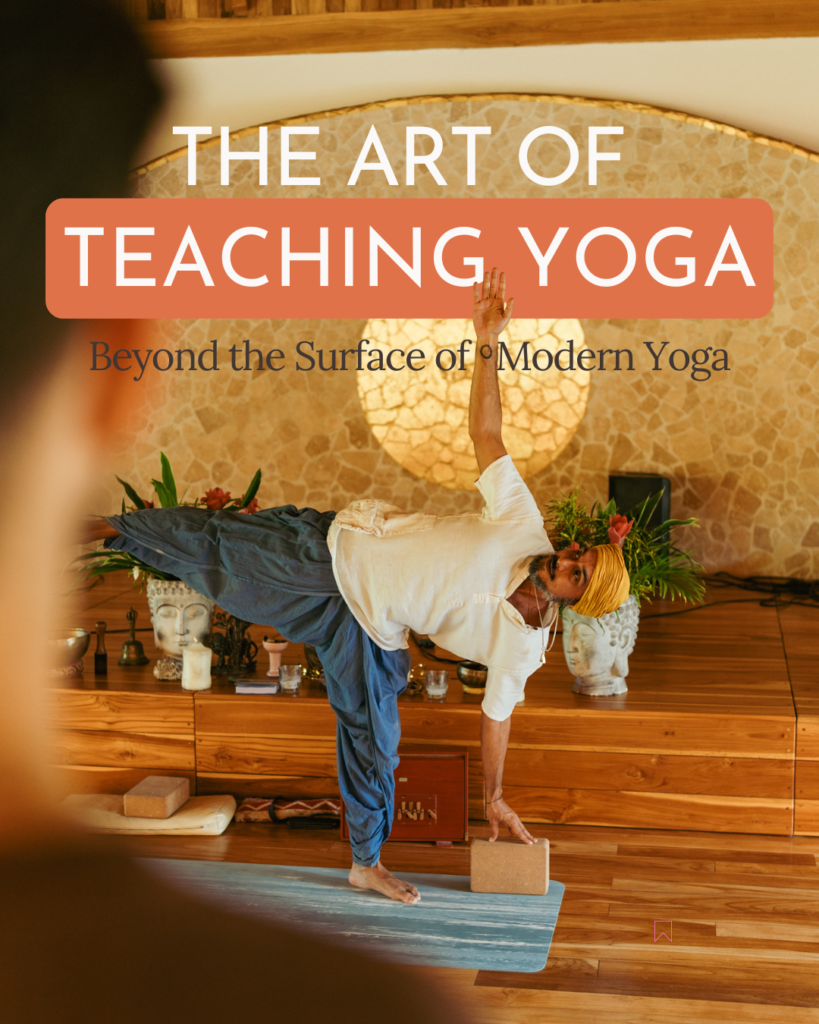

A good yoga teacher is not defined by how advanced their āsana looks, how creative their sequencing is, or how much information they can deliver.
Yoga is not bending and shaping our bodies. It is a sacred path of self-realization.
To teach it is to step into a stream that has been flowing for thousands of years. Think about it for a moment, the ancient yogis were committed, austere, deeply devoted practitioners who mapped the inner world with extraordinary precision. We owe them more than just an aerobics class.
Here are five qualities we see in teachers who truly carry this depth:
1. They remain an ever-student
A good teacher knows they are never finished. They study. They question. They refine. But not just intellectually, but also experientially.
They stay curious in their own body, in their minds, in their emotions, and even in their beliefs.
They are willing to feel more, notice more, unlearn more. They don’t just accumulate techniques and repeat them; they explore, digest, and integrate.
Because yoga is not mastered through repetition. It is revealed through awareness.
The moment someone thinks they have “arrived,” the learning stops. The good teacher bows to the path again and again.
2. They have depth in their own practice
You can feel when someone has a real practice. Not a performance practice. Not a social media practice. A lived one.
A good yoga teacher has sat with themselves. They have met resistance, discomfort, silence. They have stayed long enough for the practice to work on them.
They understand that āsana is a doorway not the destination. And that’s what they teach to their students, not in words but in wise guidance.
Their authority doesn’t come from certification. It comes from intimacy with their own nervous system, breath, mind, and inner landscape.

3. They care about yoga beyond āsana: its lineage, transmission, and aim
A good teacher knows yoga did not begin with us. It was not invented in a modern studio.
It is rooted in sophisticated philosophical, contemplative, and embodied traditions whose clear aim was self-realization = liberation through direct recognition of one’s true nature.
There is humility in remembering this.
To teach yoga is not to “play shapes” with bodies. It is to transmit something sacred. To become, in a small way, a doorway into a vast inner world that has been studied for millennia.
And yes, our modern lives are far removed from the cultural contexts in which these teachings emerged.
But the inner landscape they mapped is timeless.
When we study the scriptures, the philosophical frameworks, the traditional views. We are receiving a map. A compass. A way not to wander aimlessly in spiritual abstraction.
A good teacher knows that the depth does not come from inventing a new sequence. It comes from opening the door to what has always been here.
4. They teach from coherence and embodied wisdom
A good yoga teacher understands that who we are in any given moment is the quality of energy, thought, and feeling moving through us.
Teaching is not just what we say. It is the frequency we embody.
When our thoughts, emotions, and energy are working together, so when there is inner coherence, what comes through us is authentic and embodied.
Students don’t just hear our words. They feel our state.
A teacher who has cultivated awareness knows they are not a fixed identity: e.g. not an “angry person,” not a “loving person”, but a field of qualities that arise and pass. And through practice, they learn something powerful:
Where attention goes, energy expands.
When we consciously place attention on what refines us, opens us, and expands us, that becomes the quality we embody.
And when we teach from that place, we give students something far greater than alignment cues: we empower them with the understanding that they are free.
Free within their own body and mind.
Free to choose how they show up.
Free to shift the quality of their own being.
This is one of yoga’s great gifts.
And it can only be transmitted when it is lived.
5. They understand the sacred responsibility of teaching
Teaching yoga is not casual. It is a sacred endeavour.
When someone steps into your class, they are entrusting you with their body, their breath, sometimes their vulnerability, sometimes their longing for meaning.
A good teacher holds that with reverence.
They know they are not the source of the teachings, they are participating in a living transmission. They approach it with humility, devotion, and discernment.
They remember that the goal is not to create dependency, but depth. Not to collect students, but to empower inquiry.
Not to entertain but to invite a deeper self-reflection, one that can lead you to actualize yourself.
This is what we teach in our YTT
Our teacher training is not about producing polished instructors.
It is about forming grounded, coherent, lineage-aware, embodied practitioners.
We train you to:
– cultivate a real personal practice
– understand yoga beyond āsana
– honor its roots and aim
– embody coherence
– teach from lived awareness
– and carry the sacred responsibility of transmission with humility
Because when the roots are strong, the teaching becomes timeless.

Become a TRU YOGA TEACHER
Learn the art of guiding others in an embodied way. Transform your own depth of practice and the live’s of others.